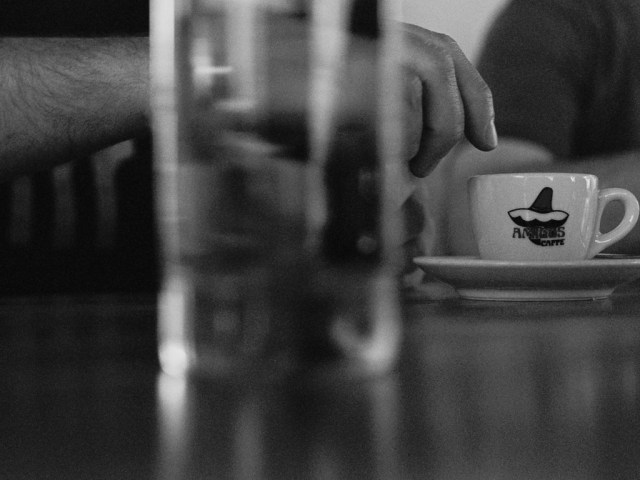
Hand of Andreas L. Hofbauer, somewhere in Slowenia after meeting with some Oxen (Photo: Eva Dertschei)

Hand of Andreas L. Hofbauer, somewhere in Slowenia after meeting with some Oxen (Photo: Eva Dertschei)
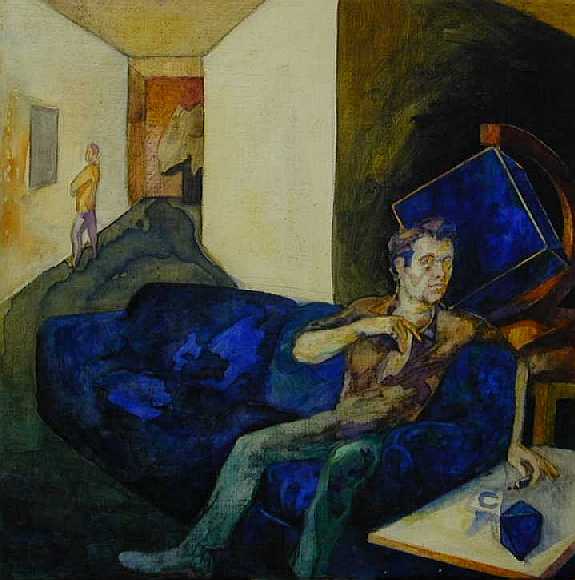
Andreas L. Hofbauer portrayed by Archi Galentz (oil on canvas)
Hier wissen wir zu leben . . . und du würdest meinen Arsch zumindest sieben Male küssen, wenn ich dir sagte, wie über alle Maßen ich glücklich bin zu leben
und dies Leben hier zu führen.
(Francisco de Goya, Brief an Martìn Zapater vom 19. Februar 1785)
Haltungsschäden sind verbreitet und werden zur Zeit gerne als Zivilisationskrankheiten definiert. Ursachen werden in allzu verfettender Nahrungsaufnahme schon bei Heranwachsenden und Jugendlichen und Bewegungsmangel derselben gesucht und gefunden. Der Ruf nach Rolfing und chinesischer Chiropraktik wird zwar zuweilen laut, freilich kann ihm aber auf Grund der notorisch leeren Staatskassen nicht flächendeckend gehorcht werden. Offensichtlich sind nicht allein die Nervenkostüme fragil geworden, sondern auch die basalen Trageeinheiten durch schleichende Osteoporose angegriffen.
Dass hier aber vielleicht eine grundsätzliche Verwechslung von Ursache und Wirkung vorliegt mag im Folgenden – vielleicht etwas gewagt anmutend – herausgestellt werden. Selten nur wird Haltung als biopsychophysischer Komplex gesehen, der auch Mensch und Artefakt ebenso wie Tier und Naturhervorbringung durchformt. Halten wir uns bei den beiden erstgenannten auf, so muss man schnell feststellen, dass es, abgesehen von den aller Orten anzutreffenden Attitüden-Korsettagen, selten geworden ist, auf ein starkes Kreuz zu treffen, da selbiges den meisten offenbar schon früh gebrochen ward.
Nun haben wir es mit Niko Sturm zweifellos mit einem jungen Maler und Mann zu tun, der sich persönlich durch Vielerlei auszeichnet. Etwa: Kraft, mutige Lebensfreude und -lust, unbedingter Wille zur Umsetzung, keine Scheu vor Konterattacken, strikte Diesseitigkeit ohne Hang zur Camouflage der Verklärung, grimmiger Humor. Kurz gesagt: nötiges Rüstzeug für einen Maler. Da hier nun aber keine individuellen Haltungsnoten vergeben werden, muss an dieser Stelle der Blick auch auf etwas gewendet werden, was ich die Haltung der Bilder nennen möchte. Eine solche verzeichnet nicht zuletzt das Grimmsche Wörterbuch, wenn auf die kompositorische Verteilung von Licht und Schatten, Tiefe und Oberfläche usw. eines Bildes verwiesen wird. Was hier aber noch ganz im Rahmen einseitiger Rezeptionsästhetik verhängt ist, ist wenigst um eine weitere Facette zu erweitern. Die Produktion oder den Austausch im Produktionsprozeß. Stehen sich Produzent und Produziertes nicht gegenüber, sondern durchdringen einander, dann gibt es allerdings auch kein Quidproquo von Aus- und Eindruck. Malakt und Lebensform ergänzen einander nicht, sondern sind die beiden Seiten einer Medaille, die sich stetig neu prägen. Eine solche Prägung muss über einen speziellen virtus verfügen, der in keiner Weise im Sinne von Gehalt zu messen oder zu refundieren ist. Dies verlangt nach einer gewissen Rückhaltlosigkeit oder Verausgabung, die das Anhalten nur als (notwendige) Etappe kennt, ehe die nächste Produktion in Angriff genommen wird. Haltung läuft deshalb kurioser Weise darauf hinaus, nicht aus einer feststehenden Position ein Objekt zu betrachten oder zu taxieren, sondern sich von diesem auch selbst angreifen zu lassen. Der Bildkörper ist ein Produktions-Halt in diesem Vorgang, der immerhin dem Körperbild den Rücken stärkt. Man könnte derartiges Herangehen auch starke Seismografie nennen, die den auf beiden Seiten heraufdrängenden Narzißmus nicht allein Paroli bietet, sondern doppelseitiger A-Narzißmus ist.
Doch, wie schon Kippenberger/Oehlen früh bemerkten, hat man es nicht leicht und selten wird einem etwas leichter gemacht.
Sämtliche Ober
zu mir
alle Banken
voller
Gier
und dann
will mein Bruder
mir nicht aufmachen die Tür,
weil er sagt, ich soll den
Schlüssel benutzen.(1)
Was auch zeigt, dass es nicht immer leicht fällt, Haltung auch zu bewahren.
Die Haltung der Bilder ist unabtrennbar mit der Haltung des Künstlers verschmolzen. Es findet ein wechselseitiges Ein- und Entströmen statt, dass sich in kristallinen Momenten – was an und für sich Bilder und Lebenshaltungen auch sind – nicht als vereist erweist, sondern als Wachstum. Was im Sturm zu gären pflegte, wird schließlich als Wein kredenzt; und nicht von ungefähr bedeutet haltig in der Bergmannsprache Erz führend. Dabei wird nicht einfach abgebaut und von Hier nach Dort transportiert, sondern der Prozeß wird zum Schmelztigel oder Krater , der aus einfachem, alltäglichem und abfälligem Material – allchymisch beinah’ –sein „Gold“ legiert. Und in diesem Glanze will und soll man auch ein Leben führen.
Und außerdem: Alle entscheidenden Türen stehen zumeist offen!
(1) Martin Kippenberger/Albert Oehlen, Gedichte (Teil 1), Berlin 1984
Andreas L. Hofbauer for Niko Sturm (exhibition Mercator foundation, Ljubljana 2004)
For months we had been trying in vain to get in touch with Virek. His immense wealth, his encyclopedic knowledge of money and his obsessive preoccupation with the more obscure aspects of the subject seemed to make him an ideal person for us to talk to.
We were finally able to get in contact with him through the K-Foundation. Some time previously, Virek had paid Bill and Jimmy an enormous sum for all the material left over from burning the million pounds – the suitcase, the video tape and of course the brick, which they had had made out of the ashes of the two thousand £50 notes. Bill gave us the name of the intermediary, who had arranged the deal at the time. The latter, a gallery owner in Wiesbaden, passed on our request for an interview to Virek. A short time later we received a laconic faxed message from the heart of Virek’s business empire, informing us, that at present Herr Josef Virek was staying at his summer home in Wörgl, in the Tyrol, and was willing to receive us there for a short conversation.
Summer home – that was a controversial and much-discussed complex of massive reinforced concrete buildings, which had only recently been built for Virek in the mountains of the Tyrol by one of the star architects from the south coast of China. The monolithic structure, in neo-bureaucratic style, was in marked contrast to Virek’s other domiciles, for example the opulent retreat, reminiscent of Ludwig of Bavaria’s fairy-tale castles, which he had built on the Venusberg, or the Synthetic Oyster Building, drifting in the sea off the Turkish coast.
We had to go through several security checks, before reaching the main building. Once we had given our names to the receptionists, we sat down in the lounge. The staff, both inside and outside the building, consisted of Orientals. If the rumours circulating about Virek were true, then these were without exception North Koreans. While we waited, we puzzled over the reasons for this idiosyncratic recruitment policy. Was it mere eccentricity? Did it provide him with greater loyalty and security? Or was it a symptom of paranoia?
After a brief wait, the butler welcomed us with exquisite courtesy and led us into the spacious library. „Please sit down. Herr Virek will be with you shortly.“ At the centre of the building, with its massive, bare walls, the library seemed almost like an oasis. At first sight, aside from the classics of literature and political economy, we also noted less familiar works; writings by Laum, Schacht and Tegtmeier, for instance. A glass case contained rare manuscripts and first editions, among them Faust, several Balzac volumes and Ludwig Wittgenstein’s manuscript of Ökonomie der Sprache, which recently turned up in a Norwegian archive. Hanging between the bookcases were numerous pictures and paintings which further reinforced the impression of being in a Wunderkammer. Particularly conspicuous among them were Brener’s adaptation of Malevich and one of Nancy Chunn’s front pages, covered in dollar signs. Through a half-open door at the far end of the room, we could see the valley below. It was roofed over by a huge glass dome and iridescent light from slopes covered in artificial snow penetrated into the library. Against a wall beside the terrace door there were a number of consoles, displaying various auratic objects: An ancient Greek skewer, an Ethiopian salt bar, the model of a helicopter. Above these objects there was a monitor showing a video kaleidoscope, looped sequences from cartoon films: Uncle Scrooge diving into his morning bath of money, Beavis and Butt-Head photocopying dollar notes, one of those crazy dialogues from Shane Simmons’ Money Talks . . . The flow of images was abruptly interrupted and the butler’s face appeared on the monitor. „Herr Virek very much regrets that, due to an unforeseen engagement, he cannot be with you in person. He will, however, be at your disposal by video link.“ His face disappeared and was replaced by the familiar features of Josef Virek in front of a monochrome background.
During the conversation, which lasted almost forty minutes, Virek was disquietingly alert and in command; his answers came very quickly, without hesitation and without displaying any discernible emotions.
You are considered to be one of the richest men in the world. Can you remember how you earned your first money?
No.
You mean that, although money is so important in your life, you no longer have any first impressions of it?
It is precisely because money is so important in my life, that I have forgotten them entirely. They would also be quite irrelevant.
Peter Drucker once said: „If all the superrich disappeared, the world economy would not even notice. The superrich are irrelevant to the economy.“ Do you agree?
Absolutely. You see, and that’s the point Drucker is making, the key economic factor has for a long time been the sum of anonymous small investors and not the individual big investor. On the other hand, there will always be individuals, who concentrate a greater amount of money in their hands than the average. It accommodates the human need for the personalisation of wealth. I think very highly of Drucker by the way, in particular his remark on Freud’s money neurosis. It was not sexual neurosis that was the outstanding phenomenon of fin de siècle Viennese society, but money neurosis. Freud himself writes in a letter to Fliess, that he had known utter poverty in his youth and had been constantly afraid of it ever since. Money was laughing gas to him. That probably explains the business sense of psychoanalysts . . .
But you don’t deny, that there’s a relationship between money and sexuality. We’re thinking of the well known photograph by Helmut Newton, which shows you posing with a large shell.
Of course. Anthropologists have plenty of theories on the relationship between early forms of money and the female genitals. Nor should we forget the historically important fact of prostitution, which is, after all, a basic constant of human society. In simple material terms alone it demonstrates the close link between money and sexuality. My coin collection for example, contains a large number of Roman brothel coins. In fact, I would go even further and suggest that there is also a relationship between sexuality and money theory. I need only mention Schumpeter, who was sexually very active and made no secret of it. – And apart from that, as you know money always makes everything easier.
You are one of the world’s most important art collectors and you have a particular interest in art with money as its theme. Looking at the paintings and graphics hanging in this room, it is noticeable that many convey a message critical of money. What do you think of artists’ criticisms’ of money?
Take, for example, Jamie Reid’s The Death of Money, which is hanging behind you. Reid was graphic artist for the Sex Pistols, who are a nice example of the ambivalence of artists and Anarchists to money. Malcolm McLaren’s maxim as manager of the Sex Pistols was „Cash from Chaos“. So it was quite consistent, when in The Great Rock ‘n’ Roll Swindle we were told: „The only notes that really count/Are the ones that come in wads.“ John Lydon, the singer of the Sex Pistols, later formed Public Image Limited and with This Is Not A Love Song wrote one of the finest hymns to money and free enterprise. „I’m going over to the other side/I’m happy to have, not to have not/Big business is very wise/I’m inside free enterprise.“ Even when an artist creates a work of art in a spirit of refusal, as agitation, he usually underestimates the possibility of affirmation on the part of the beholder. Take, as another example, Idol by Winston Smith, hanging over there in the corner above the card table. Even the figure of Christ nailed onto dollar notes, which the Dead Kennedys used on the cover of one of their records with the unambiguous intention of criticising capitalism and religion, can also be seen as entirely affirmative.
Ultimately, however, I am only interested in the aesthetic value of the critique of money made by artists. That’s the only thing that matters, when I buy a work.
There is a rumour that you are one of the financial backers of the lawyers, who are at present attempting, through the international courts of justice, to break the state monopoly on money and allow the issuing of private currencies. Is that true? And is it true that, should these actions be successful, you are thinking of issuing your own currency?
Obviously I cannot comment on proceedings, which are still pending. Nevertheless I should like to say at this point, that in a historical perspective, private money is nothing new. In the present day too there are good arguments for allowing private money. Hayek already formulated them in the last century. As to the second part of your question, I should like to say, that I created my own currency – the Virek – some time ago. I invited famous artists, like J.S.G. Boggs to design the bank notes and other bearers. I must add, however, that this is really for my own private amusement and I have no economic goals in mind. For the moment at least. But even though there are no plans for a public issue of the Virek for the moment, I certainly believe, that my currency could hold its own against other currencies.
Are you not afraid that you will be accused of vanity, if you give this currency your own name?
Not in the least. My considerations were exclusively economic ones. What would the alternative be? After endless market surveys and long reflection highly paid marketing experts would suggest a name. The name would first have to be introduced and popularised and that would require a great deal of energy and, above all, money. Since my name may already be regarded as a synonym for wealth and money, the choice is an obvious one.
Apart from a sophisticated artistic design would the Virek exhibit any other distinctive features and idiosyncracies?
It would be like every other efficiently functioning currency and it would of course have the most up-to-date safeguards against forgery. A necessary measure, even though I personally find the phenomenon of forgery very interesting. It has been of central importance since Diogenes, the cynic and counterfeiter, and not only in economic matters. What is genuine? What is fake? What has worth? What is true?
The accumulation of knowledge about money, the proliferating collections and investments – are they ultimately anything more than attempts to escape the burden of money? Or put another way: Do you fear that one day you may reach the point, where what you really want can no longer be had for money?
It’s a question I’m familiar with . . . „Money may buy you a fine dog, but only love can make it wag its tail.“ – A sentence, which Kinky Friedman likes to repeat. Nonetheless I have dismissed the question as being of no relevance to me. I have learned to regard my privileged position as one of the wealthiest men in the world primarily as an adventure, which was and is possible for very few besides myself. Top class staff allow me to reduce my involvement in everyday business affairs to a minimum. Therefore I have the time to carry out a more profound investigation of the character of money, which, as you know, is a pure intellectual and energetic concept. One of the characteristics of money, for example, is its ability to manifest itself in extreme forms of solidity and liquidity. A figure, whom at the moment I find very interesting in this context, is Vauban, who was not only a master of the construction of fortifications, but also a distinguished economist of the day.
What you say is very impressive. Nevertheless we must confess that you have not convinced us entirely. Perhaps we can turn to a literary figure to express our reservation: Lurking behind the figure of the all-powerful, self-confident Anarchist Banker is there not also his creator, the melancholic Pessoa? Can you understand this tension?
Like everyone else, I too am subject to economic constraints. More so indeed. I wish I could embrace the philosophy of money, which Dominique Aury once described as the only tenable one for her. „Holy Mother, I pray you to grant me enough fish that I may eat and feed my family, have sufficient left to give some away, and then enough more so that those who need may steal it from me.“ Unfortunately my wealth prevents me from practising that. Nor is an act of liberation, of the kind, that the K-Foundation carried out, possible for me. My wealth has taken on such dimensions, that even the possibility of destroying it is denied me. One could even say, I don’t own all the money, it owns me. The fact that I am so inextricably involved with money is not only bound up with an enormous pressure, it also produces a surplus of pleasure. A print by a young slogan artist, which I acquired recently, gets to the heart of the matter: $LAVE.
Richard Brem and Andreas L. Hofbauer for Robert Jelinek (Ed.) and Sabotage Communications. This article was published in SUBETAGE (Vienna 1999)

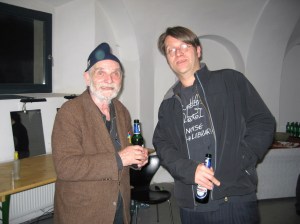
Andreas L. Hofbauer together with old boy Bob Rutman at Klangraum Krems (AT) 2007 / Danube Festival
(Photo: Susanna Kalivoda)
Andreas L. Hofbauer on Joachim Neander (2000).
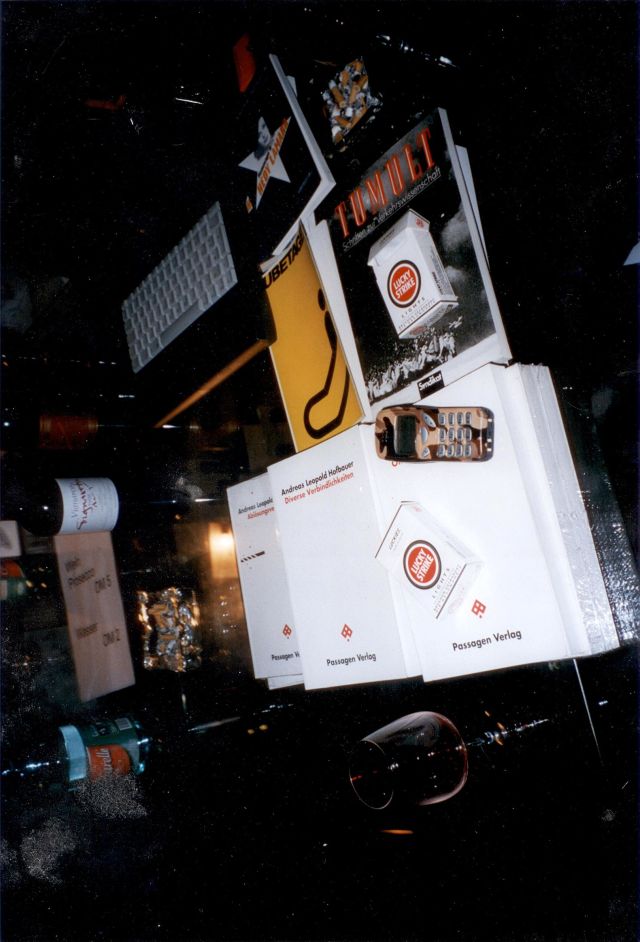
Books by the author Andreas L. Hofbauer (together with some leftovers; Photo Manfred Reuter)
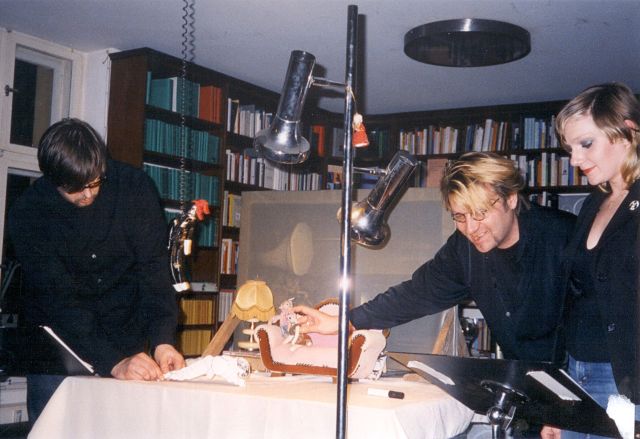
Diana Dart, Heinrich Dubel and Andreas L. Hofbauer perform a puppet show at Juliettes Literatursalon in Berlin 2002. It was reading # VXXVII in the course of the Marquis de Sade Lesemaschine.
(Photo: Manfred Reuter)
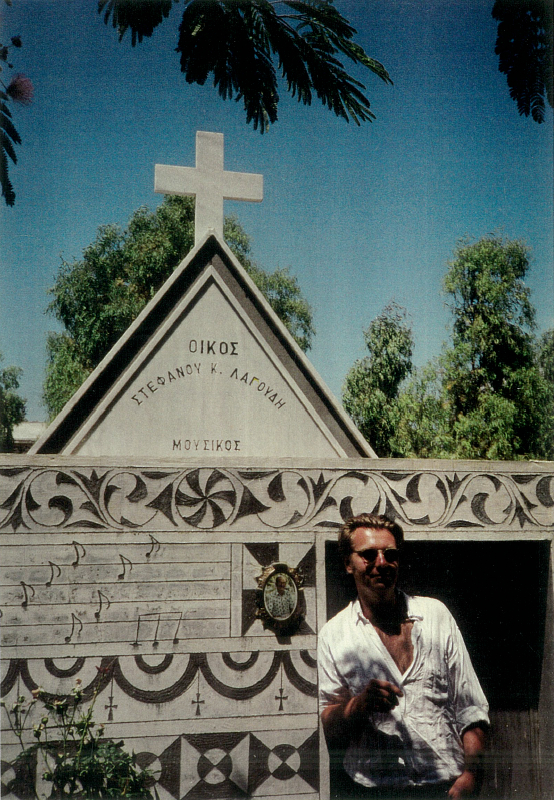
(Photo by Christina Mittag)
Andreas L. Hofbauer (author of Ökonomien der Sprache) poses in front of a greek building, giving us some hint about the real nemein of oikos.
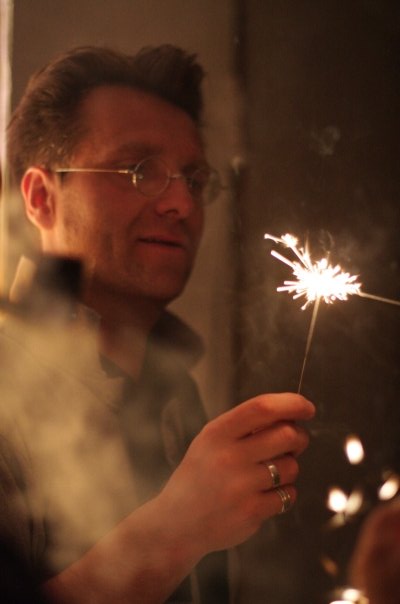
Andreas L. Hofbauer tries to bring some light into “this side of hell” (Lee Hazelwood). And prays for all the mariners who found their wet grave in the oceans of this world. (Pic by Bianca Regl)
“Ich warte. Ich weiss nicht, ob morgen die Wellen für Surfer ideal sein werden. Aber es wird ein schöner Tag, etwas kühl und metallisch, aber schön …” (Andreas L. Hofbauer)
“I had a brain tumour. And I had visions. I believe the visions caused the tumour, and not the reverse. I could feel the visions coalesce and become flesh, uncontrollable flesh. But when they removed the tumour, it was called Videodrome.” (Professor O’Blivion)

Wie wohl wäre mir, könnte ich etwas
sein, das weder Frau noch Mann wäre. Gäbe es das,
würde ich sogleich darin wohnen möchten.
(Unica Zürn)
Füttert man die Internetsuchmaschine Google mit dem Wort pandrogyn, so taucht sofort die Frage „Meinten Sie: androgyn?“ auf. Nun – nein, meinten wir nicht!
Die (englische) Wortschöpfung pandrogyne geht auf die Avantgarde- und Underground-Ikone, der Erfinder des Industrial, Musiker (Throbbing Gristle, Psychic TV), Performer und Autor Genesis P-Orridge und seine Lebensgefährtin Lady Jaye (die sich als eine Art Personalunion verstehen und unter ihrem gemeinsamen Namen Breyer P-Orridge leben und arbeiten) zurück. Ein solches pandrogyn ergänzt nicht allein eine Zweigeschlechtlichkeit und Zweideutigkeit (ausgehend von den beiden Stammsilben andr-/gyn-) um einen Buchstaben, sondern erweitert diese in Richtung eines All-Zusammenhangs, der sich von seiner binären Ausgangsidee verabschiedet. Dies wird allerdings nur durch eine altbekannte Fehlableitung möglich. Schon der antike Stoizismus hatte das griechische to pan als das All übersetzt und im logos pan menyon das alles Anzeigende ausgemacht. Dürfte die etymologisch korrekte Herleitung zwar vom mykenischen aiki-pata (Hirt/weiden) herrühren, so wollen wir uns dennoch getrost von einem creative misreading leiten lassen. Darüber hinaus handelt es sich bei pandrogyn und Stoff/Textil – von Letzterem werden wir gleich sehen, dass es die entscheidende Aufzeichnungsfläche unserer Unternehmung ist – ohnehin nicht um Begriffe. Doch spielt hier das Fehlen von Begriffsdefinitionen keinerlei Rolle, gilt doch ganz allgemein: „Wir sind unfähig, die Begriffe, die wir gebrauchen, klar zu umschreiben; nicht, weil wir ihre wirkliche Definition nicht wissen, sondern weil sie keine wirkliche ,Definition‘ haben. Die Annahme, daß sie eine solche Definition haben müssen, wäre wie die Annahme, daß ballspielende Kinder grundsätzlich nach strengen Regeln spielen.“ (Ludwig Wittgenstein)
Jenseits der mittlerweile gut eingespielten, etablierten und mit zahlreichen Meriten versehenen Gender Studies, den Verhandlungen der Geschlechterdifferenz und einem zu Weilen fröhlichen gender blending liegt, sozusagen als unbestellte und verwilderte Zone im sorgfältig kartierten Feld des Sexuellen, die Region erogener Körper. Sie sind nicht auf die Umrisse der Anatomie reduzierbar, auf die Fassungen der Biologie beschränkt oder kulturell durchgeformt. Vielmehr wird von ihnen her das ganze bislang vertraute Schema, was ein Körper sei, worin sein Erotismus bestünde und was er zu schaffen vermöchte ungewiss. Erst eine – durch eine lange Kette (etwa von Spinoza über Freud bis hin zu Butler oder Preciado) von Untersuchungen nachgewiesene – Besetzung und Produktion von Zonen körperlicher Erogenität ist dafür verantwortlich, dass und wie sich sexuelle Körper überhaupt aus- und umformen. Ihr Geschlecht ist vorerst demnach weder eins noch zwei. Sexuelle Körper werden erst über ein komplexes Signifizierungsgeflecht von Narzissmus, Alterität und passionierter Inanspruchnahme hervorgebracht. In diesem Zusammenhang also bezieht sich pandrogyn weniger auf das sexuelle oder kulturelle Geschlecht und seine Konstruktion und Repräsentation, Differenz oder Austauschbarkeit, sondern auf die Stofflichkeit erogener Formationen. Da Lust nicht vorrangig über die Funktionen des Geschlechtsapparats gesucht und gefunden wird, operiert sie vielgestaltig und merkwürdig in und an Körpern, die „Ensembles erogener Zonen“ (Serge Leclaire) sind; spiegelt sich in deren Oberflächen, durchlöchert sie, dringt in sie ein, wird von ihnen ausgestülpt, verbindet sich mit Auslagerungen anderer Körper usw. Pandrogyne Körper verstehen wir demnach als produktive Vernähungen und Verstrickungen von Phantasmen, Schnitten, Sprechakten, Gelenken, dem Denken, obsessiven Besetzungen etc., die den Ausbildungen von Körperbildern und Identifizierungen vorausgehen. Sie sind chiasmatisch (χ) und ausgefranst. Unregelmäßige Umschläge von CHI und ICH.
Pandrogyne Körper beschränken sich keineswegs auf menschliche Körper. Sie entstehen auch aus verschiedenartigen Mischverhältnissen mit nicht-menschlichen und so genannten unbelebten Gegenständen und sind folglich Kompositkörper. Weichen sie auch weitgehend den Rastrierungen von gender und sex aus oder erweitern diese erheblich, so bedeutet das freilich nicht, dass diese Dimensionen nichts mit ihnen zu tun haben. In erster Linie aber sind pandrogyne Körper psychoplastische! Pandrogyn bringt folglich den Aspekt der Plastizität ins Spiel, anstatt, wie gesagt, weiter den Ordnungen von Repräsentation, Mimesis und Rollenperformanz zu gehorchen, die unter der Herrschaft einer ideologisch erpressten Flexibilität stehen. Auch hinsichtlich des Aspekts einer gegenkulturellen Taktik sollte dabei nicht übersehen werden, dass eine solche Plastizität so manche Formen schafft und generiert, andere zugleich aber auch sprengt.
Ich bin der Stoff, der mich umhüllt. Dies ist auch ein Kurzschluss von Auto- und Panerotik. In der Wirklichkeit dieser Annahme ist das Pandrogyne mit dem Textilen verflickt. Man braucht daher gar nicht auf die esoterische Idee zurückgreifen, dass alle Materie Stoff des ehemaligen Kleides der aus dem höchsten Himmel gestoßenen Engel sei und die dem Menschen von Gott zugewiesene Arbeit darin bestünde, dieses Kleid wieder zu retten (Alchymie). Man erkennt auch ohne diese Erzählung leicht, dass die Leidenschaft am Stoff zwischen etwas Engelhaftem und dem Obszönen changiert. Die Einfalt des nackten Körpers und des reinen Geistes (die es recht eigentlich gar nicht geben kann) wird mit einer Vielzahl von verführerischen Implikationen geimpft, die von der Drapierung zur Hosennaht, von der Wand zum Gewand reichen. Und im Zuge dessen werden einige beliebte Fragen überflüssig, andere gewinnen an Kontur: Gibt es einen weiblichen Fetischismus? Warum nicht! Kann man ohne phantasmatische Stütze wahrnehmen? Natürlich nicht! …
Eine Politik der Geister und eine Politik der Körper sind bloß zwei Seiten derselben Münze. Die entscheidende Erweiterung liegt in den leidenschaftlichen (und zu Weilen obsessiven) Besetzungen von Fleisch – Textilie – Stoff (Schnitt – Naht – Oberfläche). Diese Verhältnisse kann man nicht auf die Schnelle einsacken, bei einer Semiotik der Mode innehalten oder begeistert im Funduskämmerchen der Kostümkunde stöbern. Vielmehr tastet man sich mehr oder weniger behutsam entlang von Säumen, Falten, Schlitzen vor. Keine Auseinandersetzung pandrogyner Körper kann solitär bleiben; sie ist immer eine Auseinandersetzung mit dem Anderen und anderen. Pandrogyn und Stoff sind Objekt und Subjekt ihres Genießens. Alles andere wäre ohnehin untragbar – oder unerträglich. Nicht von ungefähr gibt es bei den Weberinnen der Navahos den Brauch, keine Textilie gänzlich fertig zu weben oder mit einem umfassenden Saum zu versehen, sondern irgendwo im Gewebe eine Lücke offen zu halten.
Bei all dem hebt natürlich auch der Gott Pan – zum Abschluss soll dies noch einmal deutlich betont werden – sein Haupt. Der große Gott der Felder und Weiden, der vielleicht gar nicht so tot ist, wie es der Mythos beklagt. Auch seine Erscheinung ist eine pandrogyne und gekennzeichnet von einer faunischen Sinnlichkeit, die sich aber auch mit einer tiefen Fremdheit und Kälte gegen über allem, was ihn umgibt, paart. Sein Wesen ist durchaus auch eines des Sich-nicht-Verbindens. Seine Ek-stase ein Abgang von der Idolatrie des Menschengeschlechts. Damit beweist sich aber wiederum nur aufs Neue, dass das Gewirk von Schuss und Kette eine ebenso gegenstrebige Fügung ist, wie das Spiel von Bogen und Leier.
Ob die überschwängliche Begrüßung des Pandrogynen als „open source myth of creation“ (Breyer P-Orridge) gerechtfertigt ist, bleibt abzuwarten. Das Signum des pandrogynen Mythos wird jedoch gewiss S/He is Her/E lauten.
Andreas L. Hofbauer for Mein heimliches Auge XXII (2007/2008) Konkursbuch Verlag Tübingen

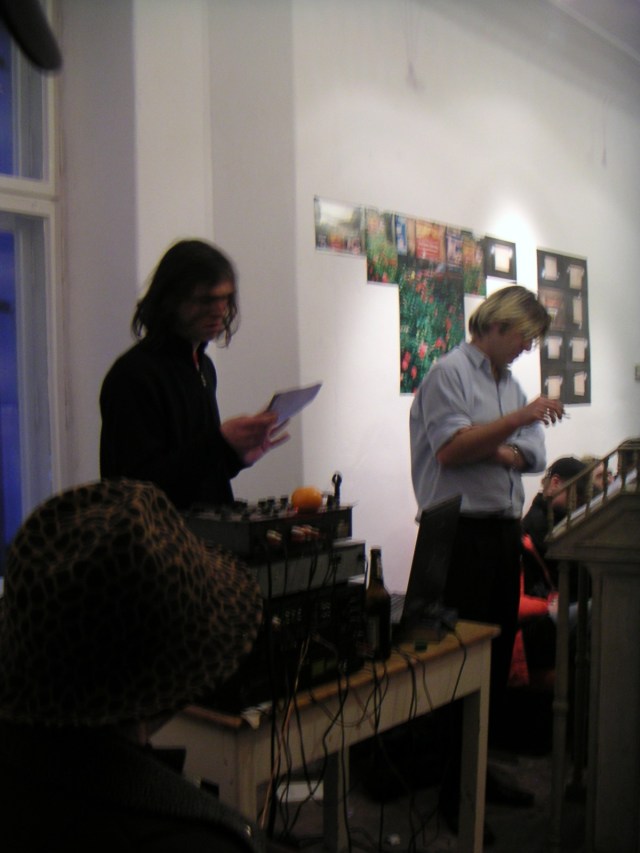
Alexander Christou (music and own texts) together with Andreas L. Hofbauer (reading Herman Melville and own stuff) for the Opening of Volapük Bookshop in Berlin 2006.

 TONOS
TONOS 